Sunday, March 21, 2021

Mark 15:42-47 — Crucifixion Courage


Mark 15:42-47 
And when evening had come, since it was the day of Preparation, that is, the day before the Sabbath, Joseph of Arimathea, a respected member of the council, who was also himself looking for the kingdom of God, took courage and went to Pilate and asked for the body of Jesus.
Pilate was surprised to hear that he should have already died. And summoning the centurion, he asked him whether he was already dead. And when he learned from the centurion that he was dead, he granted the corpse to Joseph.
And Joseph bought a linen shroud, and taking him down, wrapped him in the linen shroud and laid him in a tomb that had been cut out of the rock. And he rolled a stone against the entrance of the tomb.
Mary Magdalene and Mary the mother of Joses saw where he was laid.

Comments:
Jesus died on the cross as discussed in my last post. However, it is hard to believe that after all he suffered, many have thought that he wasn’t really dead. However, the expert testimony is in…be it medical forensics or simply one who would know better than any other when someone on a cross was dead…the centurion. Death on a cross comes by suffocation as the lungs fill with fluid and the victim has to pull themselves up to breathe. The legs of the other prisoners were broken to speed up the process, but Jesus at that point was already dead. Just to be sure the soldiers inserted a spear into his side and pierced the pericardium. The blood and “water” that came out also indicated he was dead.

What is surprising is the change in Joseph of Arimathea and Nicodemus (John 19:38-40) from secret followers to men bold enough to go to the governor to request Jesus’ body in order to bury in his own tomb. It seems that Jesus’ death impacted them at least as much as it did the Centurion. Once obtaining Jesus' body they wrapped it in linen soaked in myrrh and aloes.

John 19:38-40 After these things Joseph of Arimathea, who was a disciple of Jesus, but secretly for fear of the Jews, asked Pilate that he might take away the body of Jesus, and Pilate gave him permission. So he came and took away his body. Nicodemus also, who earlier had come to Jesus by night, came bringing a mixture of myrrh and aloes, about seventy-five pounds in weight. So they took the body of Jesus and bound it in linen cloths with the spices, as is the burial custom of the Jews.

When we can see the death of Christ, as it really was, and that it was for our sins how could we be unchanged? His selfless death changed formerly fearful "secret" believers into courageous followers...even if only to bury his body with respect.


I wonder how our own testimonies of faithfulness will motivate future generations of Christ-followers to greater courage and belief? 

May we finish well and may our faith produce good fruit!

Sunday, March 14, 2021

Mark 15:33-41 — The Centurion’s Conclusion

 Mark 15:33-41 

And when the sixth hour had come, there was darkness over the whole land until the ninth hour. 
And at the ninth hour Jesus cried with a loud voice, “Eloi, Eloi, lema sabachthani?” which means, “My God, my God, why have you forsaken me?” 
And some of the bystanders hearing it said, “Behold, he is calling Elijah.” 
And someone ran and filled a sponge with sour wine, put it on a reed and gave it to him to drink, saying, “Wait, let us see whether Elijah will come to take him down.” 
And Jesus uttered a loud cry and breathed his last. 
And the curtain of the temple was torn in two, from top to bottom. 
And when the centurion, who stood facing him, saw that in this way he breathed his last, he said, “Truly this man was the Son of God!”
There were also women looking on from a distance, among whom were Mary Magdalene, and Mary the mother of James the younger and of Joses, and Salome. When he was in Galilee, they followed him and ministered to him, and there were also many other women who came up with him to Jerusalem.


Comments:

How will Jesus respond to all the pain, rejection, and humiliation he was experiencing? 
While the account here in Mark is characteristically brief, when we read the Gospels horizontally we can build a rather detailed harmony containing all of Jesus' statements from the cross that shows us how he responded. However, in this gospel characterized by action, and written for a Roman audience perhaps the key is the response of the Roman centurion, “Truly this man was the Son of God!”  Whatever he saw in word and deed was enough to convince the previously hostile Roman soldier that this innocent man was also "the Son of God". Here is a classic cameo of John Wayne as the Centurion, "Awww, truly, this man was the Son of God."

Certainly, this would have been the hope of the Evangelist that those who would see Jesus’ actions through the pages of this gospel would come to the same conclusion. As we have read through the Gospel of Mark together over the last several months, what conclusions have we come to about Jesus Christ? Is he who he said he was or just a crazy messianic "wannabe"? He can't be merely a good teacher or a prophet. He is either a liar, a lunatic, or the Lord! I have come to believe that it is the latter! He has saved me by his own blood.

------------------------------------------------------------

Just in case you wanted me to harmonize Jesus’ seven last sayings on the cross (which have been the subject of many great sermons) see the list below.
  1. “Father, forgive them, for they know not what they do.” (Luke 23:34) It’s not surprising to me that the first word on the cross is a prayer, for God to forgive those who were so cruelly abusing him.
  2. “Truly, I say to you, today you will be with me in Paradise.”  (Luke 23:43). This second word was an answer to prayer, that of a single individual. The one thief who realized that he was getting what he deserved for his crimes but that Jesus was innocent…and the rightful king.
  3. "Dear woman, here is your son," and to the disciple, "Behold, your mother." (John 19:26-27) Jesus, as the eldest son took a moment, even in excruciating pain and struggling to breathe on the cross, to care for his mother. He gives her into the care of the Apostle John.
  4. “Eloi, Eloi, lema sabachthani?” which means, “My God, my God, why have you forsaken me?”  (Matthew 27:46; Mark 15:34) Jesus felt forsaken on the cross because he took all our sin upon himself and in that moment felt a separation from the Father that he had never previously known.
  5. “After this, Jesus, knowing that all was now finished, said (to fulfill the Scripture), ‘I thirst.’” (John 19:28) This is the culmination of what we call “the Passion of Christ.” It is important to realize that passion does not mean "feelings of love" but rather experiencing "suffering & agony." Christ's suffering (passion) was the price God's love paid to buy us back from our own destruction.
  6. “It is finished.” (John 19:30; likely the “loud cry” of Mark 15:37). The single Greek word Jesus spoke here (tetelestai) was the word stamped on a bill when it is paid in full, or on a prisoner’s list of charges when all their time in prison has been served.
  7. “Father, into your hands I commit my spirit!” (Luke 23:46; John 19:30) Jesus wasn’t murdered; John makes it clear that he gave up his life willingly. From the circumstances at his arrest, to his conduct at his trial, and finally in the dismissing of his own spirit, Jesus is seeing to surrender his life for us willingly. 

Tuesday, December 1, 2020

Mark 15:21-32 — Exposed

Mark 15:21-32

And they compelled a passerby, Simon of Cyrene, who was coming in from the country, the father of Alexander and Rufus, to carry his cross.
And they brought him to the place called Golgotha (which means Place of a Skull).
And they offered him wine mixed with myrrh, but he did not take it.
And they crucified him and divided his garments among them, casting lots for them, to decide what each should take.
And it was the third hour when they crucified him.
And the inscription of the charge against him read, “The King of the Jews.”
And with him they crucified two robbers, one on his right and one on his left.
Golgotha (the Place of the Skull), 
now looks down on an Arab bus station.
And those who passed by derided him, wagging their heads and saying, “Aha! You who would destroy the temple and rebuild it in three days, save yourself, and come down from the cross!”
So also the chief priests with the scribes mocked him to one another, saying, “He saved others; he cannot save himself. Let the Christ, the King of Israel, come down now from the cross that we may see and believe.”
Those who were crucified with him also reviled him.

Comments:
Because Jesus had been so brutalized, with pain, blood loss, and shock taking their toll he could no longer carry his own cross. Remember that Roman soldiers could compel people to carry their load for them for up to a mile (Jesus taught people to go one more). I think this situation was a little different but Simon at least got his name in the Bible for this filling this role.

Athol Dickson wrote a gripping novel (Lost Mission) featuring a mysterious and centuries-old triptych[1] that could reveal the spiritual condition of the viewer by placing their likeness somewhere in the three-panel painting of the crucifixion. If we had to put ourselves into such a picture of the crucifixion of Jesus who would we be?

While we would like to imagine ourselves being represented by figures such as a grieving Mary, a responsible John, or a heroic servant figure like Simon of Cyrene, a more honest look inside our hearts exposes the truth and finds us…
in the soldiers' torture and tearing,
in Pilate’s giving in to pressure,
in the priests' testing,
in the “Aha!” and the “tsk-tsking” of those passing by,
in the thieves' reviling…

Yet it was for this moment that Christ had come. It was for these people, and it was for us. He went to the cross in complete submission to the will of God and experienced the physical, social, and spiritual pain, agony, and humiliation, full-strength rejecting the local anesthetic offered at the cross. One aspect of his humiliation that we don’t seem to spend much time thinking about is Jesus' emotional humiliation.  

What role did we play?

In our next post, we will consider Jesus' responses on the cross.

If you are interested in reading more about the emotional humiliation of Christ, the following is an excerpt from my “Do You See Him?” curriculum that I have used in some of my Bible classes.

Jesus' humiliation also applied to His emotions.  His feelings were crushed by the betrayal, the denial, the torture, and the public mocking.  But there is one thing further that struck me with new force as I again studied the accounts of His crucifixion.  The Bible says that He was stripped of His clothing by the soldiers in the courtyard when they mocked Him, and again at the cross.  As it is written,

Matthew 27:28 "They stripped him and put a scarlet robe on him, and then twisted together a crown of thorns and set it on his head."

John 19:23-24 "When the soldiers crucified Jesus, they took his clothes, dividing them into four shares, one for each of them, with the undergarment remaining.  This garment was seamless, woven in one piece from top to bottom.  'Let's not tear it,' they said to one another.  'Let's decide by lot who will get it.' This happened that the scripture might be fulfilled which said, 'They divided my garments among them and cast lots for my clothing.' So this is what the soldiers did."

I don't know if you have ever thought about it before, but it would seem from the context that they stripped Him naked.  How humiliating that must have been for the God of the entire Universe, the One who was without sin, to be stripped naked for all to see.  In art and in movies, of course, we see Jesus still covered by a loincloth type of garment, but in reality that was probably not the case.  Perhaps we can see a hint of the public's attitude and of Jesus' pain in the words of the psalmist,

Psalm 22:16-19 "Dogs have surrounded me; a band of evil men has encircled me, they have pierced my hands and my feet.  I can count all my bones; people stare and gloat over me.  They divide my garments among them and cast lots for my clothing.  But you, O LORD, be not far off; O my Strength, come quickly to help me."

The people were staring and gloating over Jesus.  Can you think of anything more humiliating, if you have any modesty or discretion at all than to be abused terribly and then hung completely naked and helpless for all your enemies and your loved ones to see?  I can't.  Forgive me for being so graphic but I don't want us to miss the full impact of Jesus' complete emotional humiliation.  It is written,

Psalm 35:11-12,19 "Ruthless witnesses come forward; they question me on things I know nothing about.  They repay me evil for good and leave my soul forlorn . . . Let not those gloat over me who are my enemies without cause; let not those who hate me without reason maliciously wink the eye."

Psalm 69:19-21 "You know how I am scorned, disgraced and shamed; all my enemies are before you.  Scorn has broken my heart and has left me helpless; I looked for sympathy, but there was none, for comforters, but I found none.  They put gall in my food and gave me vinegar for my thirst."

Just as our sin, if not covered by God's grace, will one day be exposed, and laid naked for all to see, so Jesus, as he became sin for us, submitted to the humiliation of nakedness that began in the garden so long ago.


[1] A free-standing altarpiece made of three hinged panels, painted with related scenes. 

Friday, November 20, 2020

Mark 15:16-20 — Robes & Reeds: How Jesus Was Mocked

Mark 15:16-20

And the soldiers led him away inside the palace (that is, the governor's headquarters), and they called together the whole battalion. 
And they clothed him in a purple cloak, and twisting together a crown of thorns, they put it on him. And they began to salute him, “Hail, King of the Jews!” 
And they were striking his head with a reed and spitting on him and kneeling down in homage to him. 
And when they had mocked him, they stripped him of the purple cloak and put his own clothes on him. 
And they led him out to crucify him.

Comments:
Christ Mocked by Soldiers, Roualt (1932)
In this short but painful section, we see many prophecies fulfilled. Jesus' own words were fulfilled. Remember how Jesus had predicted this back in Mark 10:33-34,
“See, we are going up to Jerusalem, and the Son of Man will be delivered over to the chief 
priests and the scribes, and they will condemn him to death and deliver him over to the Gentiles. And they will mock him and spit on him, and flog him and kill him. And after three days he will rise.”

When I read how they mocked Jesus, I can’t help but think about Psalm 1:1-2...
Blessed is the man
    who walks not in the counsel of the wicked,
nor stands in the way of sinners,
    nor sits in the seat of scoffers;
but his delight is in the law of the Lord,
    and on his law he meditates day and night.

We are not to be among the mockers…and yet at times, I wonder if our hypocrisy and stiff-necked responses to his claims don’t put us there!

They dressed him in purple, as a king and mocked him—for if he was indeed a king it was only a king of the Jews, which in the eyes of the Roman soldiers was not worthy of any true honor. [On a side note, the color purple, was present in the original Tent of Meeting (Exodus 26) where God gave very specific instructions. for its construction.  The veil was made of blue, red, and purple yarns—blue above (the color of divinity), red below (the color of man), and purple in the middle (the color of the Messiah, our great high priest who was both God and man Hebrews 2:14).] The robe was on his shredded back (from the scourging) just long enough for it to stick and start to scab…then they tore it off like a huge Band-Aid.

The scoffers of David’s time, the mockers of the passion of Christ, and the situation will be the same in the last days, as Peter would write,

 “This is now the second letter that I am writing to you, beloved. In both of them I am stirring up your sincere mind by way of reminder, that you should remember the predictions of the holy prophets and the commandment of the Lord and Savior through your apostles, knowing this first of all, that scoffers will come in the last days with scoffing, following their own sinful desires. They will say, “Where is the promise of his coming?” (2 Peter 3:1-4)

Will we see his amazing love poured out for us or will we settle for scoffing?

Wednesday, November 18, 2020

Mark 15:6-15 — The Voice (to Which We Listen)

 Mark 15:6-15

Now at the feast he used to release for them one prisoner for whom they asked. And among the rebels in prison, who had committed murder in the insurrection, there was a man called Barabbas.
8 And the crowd came up and began to ask Pilate to do as he usually did for them.
9 And he answered them, saying, “Do you want me to release for you the King of the Jews?” 10 For he perceived that it was out of envy that the chief priests had delivered him up.
11 But the chief priests stirred up the crowd to have him release for them Barabbas instead.
12 And Pilate again said to them, “Then what shall I do with the man you call the King of the Jews?” 13 And they cried out again, “Crucify him.”
14 And Pilate said to them, “Why, what evil has he done?”
             But they shouted all the more, “Crucify him.”
15 So Pilate, wishing to satisfy the crowd, released for them Barabbas, and having scourged Jesus, he delivered him to be crucified.

Comments: 
The Governor—Pilate—listened to the people more than he listened to the voice of justice or the voice of his wife’s warning to have nothing to do with the innocent man Jesus (Matthew 27:19). Even though he sought to release Jesus, he was more afraid of the priests’ threat that to pardon Jesus would endanger his standing with Caesar. Pilate not only feared any potential loss of his position, but he too feared death and was enslaved by it.

The crowd—at least those allowed near Pilate—listened to the voice of the priests for whatever reward or in response to whatever intimidation they offered.

The chief priests listened to their own appetite for power and their fear of losing it. 
Can you hear the devil’s voice whispering, persuading, shouting, intimidating? Or are we swayed by appearances to choices less than just, less than loving, less than faithful to the vocation/calling God has placed on our lives? 

All three groups or individuals here was under the influence of demonic wisdom as described in James 3:14-16,
But if you have bitter jealousy and selfish ambition in your hearts, do not boast and be false to the truth. This is not the wisdom that comes down from above, but is earthly, unspiritual, demonic. For where jealousy and selfish ambition exist, there will be disorder and every vile practice.
  
In contrast, the wisdom from above is described in James 3:13, 17-18,
Who is wise and understanding among you? By his good conduct let him show his works in the meekness of wisdom… But the wisdom from above is first pure, then peaceable, gentle, open to reason, full of mercy and good fruits, impartial and sincere. And a harvest of righteousness is sown in peace by those who make peace.

There are voices all around us. To which voice will we listen? The fearful voices of selfish ambition or the gentle, pure, sincere, voice of the wisdom of God?

In a nod to The Voice (the popular singing talent show famous for their blind auditions where the judges/coaches can't see the contestant until they have heard enough to decide if they want them on their team), what voice is it that will make us "turn our chair" this week? 

Lord Jesus, give us an ear to hear your voice above all the others!

Friday, November 6, 2020

Mark 15:1-5 — Are You the King of the Jews?

Mark 15:1-5
And as soon as it was morning, the chief priests held a consultation with the elders and scribes and the whole council. And they bound Jesus and led him away and delivered him over to Pilate.
And Pilate asked him, “Are you the King of the Jews?”
And he answered him, “You have said so.”
And the chief priests accused him of many things.
And Pilate again asked him, “Have you no answer to make? See how many charges they bring against you.”
But Jesus made no further answer so that Pilate was amazed.

Comments:
Jesus was taken to Pilate and said nothing except to answer as to his identity that Pilate had called him the King of the Jews. As I have written previously, Jesus didn't defend himself against the false charges or the incomplete naming. So much is said today about the oppressor’s habit of naming the oppressed, but here Pilate names Jesus “King of the Jews” and Jesus didn’t object. Was Jesus the king of the Jews? Yes, but that was not everything that he was—he was so much more! Yet he felt no need to correct Pilate’s condescension.

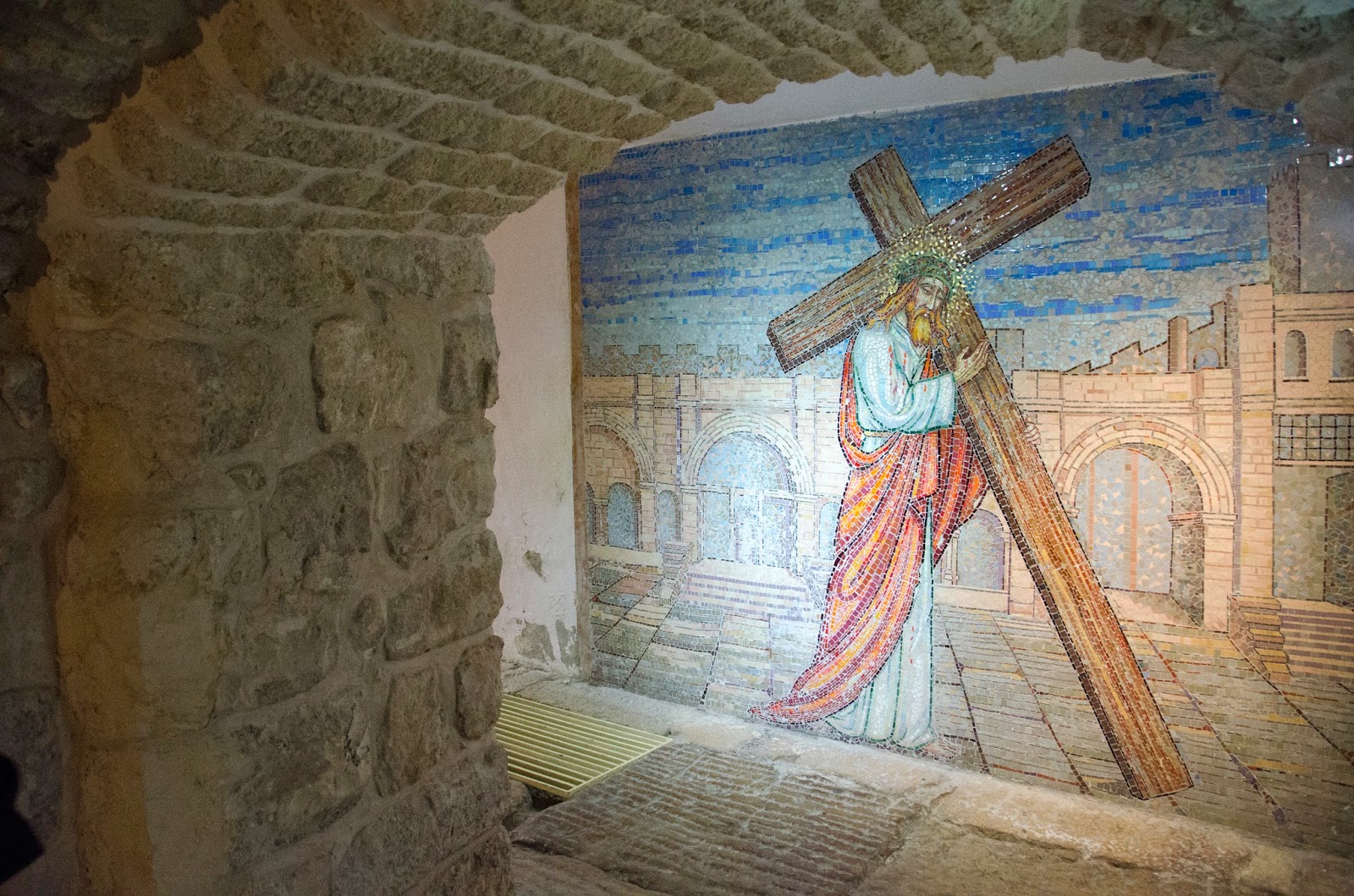
Jesus carries his cross--mosaic in Jerusalem
Governments tend to be threatened by the authority of Jesus which is historically present in the lives of his followers. Ultimate authority does not rest with Caesar and for most rulers and realms this inflames their inferiorities and persecution spill over onto the church. However, like Christ, those who have come to realize that Jesus’ death and resurrection have removed the penalty of sin and opened up access to eternal life. Hence, what fear is there in death? If we don’t fear death it shows the superiority of the kingdom that we serve. Remember, Jesus came to set us all free from the fear of death, as it says in Hebrews 2:14-18,
“Since therefore the children share in flesh and blood, he himself likewise partook of the same things, that through death he might destroy the one who has the power of death, that is, the devil, and deliver all those who through fear of death were subject to lifelong slavery. For surely it is not angels that he helps, but he helps the offspring of Abraham. Therefore he had to be made like his brothers in every respect, so that he might become a merciful and faithful high priest in the service of God, to make propitiation for the sins of the people. For because he himself has suffered when tempted, he is able to help those who are being tempted.”

He set us free from the fear of death! And because state control is ultimately related to the fear of death—we are no longer oppressed by the fear of death, because we have received eternal life in Jesus Christ. We don’t ever stoop to trying to establish the kingdom by force by attacking the servants of the oppressors like Peter did, but we explicitly trust in the heart of God and the Spirit of God to bring about the plan of God. If we overcome, in Christ, Jesus promises to give us a new name. 
"He who has an ear, let him hear what the Spirit says to the churches. To the one who conquers I will give some of the hidden manna, and I will give him a white stone, with a new name written on the stone that no one knows except the one who receives it.’" (Rev. 2:17).
So even when people consider us less than we really are we can like Jesus accept the part that is true, and trust God for the rest. 

Jesus knew his life was in the Father's hands. He knew his life was being given as a ransom for even those who attacked him. He knew who he was as the Father had named him, “Jesus” (Matthew 1:21; lit. Yahweh is Salvation) and declared, “You are my beloved Son; with you I am well pleased” (Mark 1:11)

But here in this moment of trial…
  • I wonder as to the expressions upon his face, the sense of eternity in his eyes.
  • I wonder how the priest and leaders felt when he looked them in the face.
  • I wonder if his countenance, though bruised and disfigured, glowed with the radiance of a pure spirit. Certainly, Pilate wondered and marveled at Christ.


Wednesday, November 4, 2020

Mark 14:66-72 — The First Rooster Crowed

 Mark 14:66-72

The Denial of St. Peter by Caravaggio
And as Peter was below in the courtyard, one of the servant girls of the high priest came, and seeing Peter warming himself, she looked at him and said, “You also were with the Nazarene, Jesus.” 
But he denied it, saying, “I neither know nor understand what you mean.” And he went out into the gateway and the rooster crowed. 
And the servant girl saw him and began again to say to the bystanders, “This man is one of them.” 
But again he denied it.
And after a little while the bystanders again said to Peter, “Certainly you are one of them, for you are a Galilean.” 
But he began to invoke a curse on himself and to swear, “I do not know this man of whom you speak.” 
Photo by chuttersnap-xNCRkHVEqMY
 on unsplash

And immediately the rooster crowed a second time.
And Peter remembered how Jesus had said to him, “Before the rooster crows twice, you will deny me three times.” 
And he broke down and wept.

Comments:
In these verses, we have the story of Peter's infamous three-fold denial of the Lord. Having tried to stand with the sword and having been rebuked by Jesus, Peter had fled with the others. Then, most likely tormented by his own cowardice and failure, he tried to follow the Lord again "at a distance" (v. 54). Peter was following in his own strength, still trying to keep his promise but he could not pull it off. I picture him coming into the courtyard incognito complete with "trench toga" and dark glasses and trying to warm himself by the fire along with the people of the household. But his plan was foiled. He was recognized by a servant girl as having been with Jesus, but he quickly lied about knowing the Lord, and to maintain his cover he withdrew to the porch and a rooster crowed.

If I were to give a title to this passage it would be the rather King James-ish sounding "And the First Cock Crew." Why would I choose this title? As I mentioned in a previous post, there is something very powerful about the message of the first cock crowing. Jesus had told Peter that he would deny Him three times before “the cock crew twice.” Peter had denied the Lord once when the rooster crowed for the first time. Would that not serve to remind Peter of his vow and of the Lord's prophecy? Would one rooster be enough to turn him back from his path of denial? It seems that Peter gave no thought to that first wake-up call. I wonder how often our gracious Lord gives us the first rooster to wake us up and turn us back to him and his ways. I also wonder how often we pay no heed, or if we do notice we merely determine to try harder in our own strength and willpower rather than turning to the Lord in dependent prayer. Peter trusted in his own resources and failed the Lord. He lied (v. 68), he denied (v. 70), he even vilified (v. 71), then he "woke up" and went out and cried (v. 72).

Imagine Jesus, sitting in the court of the high priest being lied about and slandered by false witnesses, yet listening to one of your closest friends lie about even knowing you. Certainly, Jesus could hear Peter's vehement replies in the courtyard below, perhaps he heard little of the mock trial going on around him as his mind focused on the drama being played out in the shadows and firelight below. What does this tell us about Jesus? As I wrote previously, he was taking the rap for Peter even as Peter cursed and swore to others that he didn't know Him. Jesus also took the rap for us even when we did the same thing Peter did. 

Then the second cock crew and Jesus turned and looked at Peter (Luke 22:61) and Peter was never the same. There was no denying his actions. But thankfully it didn’t end there.

Previously Jesus had prayed that when Peter returned that he would have a great ministry for the Lord. Peter began to mourn right there and Jesus would pay the price for Peter's sin, the next afternoon by dying on the cross. 

Later, Peter’s full restoration took place on the shores of Galilee with Jesus’ thrice-repeated question, “Simon, do you love me?” (John 21:15-19). Then on the Day of Pentecost, Peter, empowered by the Holy Spirit, would speak boldly regarding Jesus Christ and 3,000 would be saved (Acts 2).

Have we seen Jesus look at us the same way—with deep love despite our painful failures? 
"Blessed are those who mourn for they shall be comforted" (Matthew 5:4). 

What is his love empowering us to do for him today?

Monday, November 2, 2020

Mark 14:53-65 — He Took The Fall

 Mark 14:53-65

And they led Jesus to the high priest. And all the chief priests and the elders and the scribes came together. And Peter had followed him at a distance, right into the courtyard of the high priest. And he was sitting with the guards and warming himself at the fire. Now the chief priests and the whole council were seeking testimony against Jesus to put him to death, but they found none. For many bore false witness against him, but their testimony did not agree. And some stood up and bore false witness against him, saying, “We heard him say, ‘I will destroy this temple that is made with hands, and in three days I will build another, not made with hands.’” Yet even about this their testimony did not agree. And the high priest stood up in the midst and asked Jesus, “Have you no answer to make? What is it that these men testify against you?” But he remained silent and made no answer. Again the high priest asked him, “Are you the Christ, the Son of the Blessed?” And Jesus said, “I am, and you will see the Son of Man seated at the right hand of Power, and coming with the clouds of heaven.” And the high priest tore his garments and said, “What further witnesses do we need? You have heard his blasphemy. What is your decision?” And they all condemned him as deserving death. And some began to spit on him and to cover his face and to strike him, saying to him, “Prophesy!” And the guards received him with blows.
Where they likely kept score in the "Kings Game" 
as they beat Christ. It was carved into the paving stones.
Comments:
Many years ago I published an article in a national magazine that was based on this passage, specifically v. 61-62, my article was entitled, “He Took the Fall.”  I include it here as a way to begin the Lenten season.

He Took the Fall

“He will not cry out, nor raise His voice, nor cause His voice to be heard in the street. A bruised reed He will not break, and smoking flax He will not quench; He will bring forth justice for truth.” (Isaiah 42:2-3, NKJ)

"But He kept silent and answered nothing. Again the high priest asked Him, saying to Him, 'Are You the Christ, the Son of the Blessed?' Jesus said, 'I am. And you will see the Son of Man sitting at the right hand of the Power, and coming with the clouds of heaven.' " (Mark 14:61-62 NKJ)

Though I have read it many times, the story of Jesus of Nazareth being arrested and dragged into a hostile court in the middle of the night still amazes me. He was mishandled, abused, and falsely accused, yet He made no answer, offered no protest, and mounted no defense. I wonder, could Jesus have been shielding someone by His silence? Was He taking the rap, the fall, the heat, out of love for someone else? I've watched enough lunch-time Perry Mason re-runs to know when the accused is trying to protect someone by not telling all they know. Jesus could have gotten Himself off the hook, but He didn't. I am forced to ask, “So why didn’t He?” I believe He kept quiet because He was deliberately taking the blame for someone He loved. But there was a problem with Jesus' plan—just one…His accusers couldn't find any grounds to convict Him, even with a multitude of lying witnesses.

The judge wanted to condemn Him. The jury wanted to convict Him. The witnesses wanted to frame Him. But they couldn't find a reason. Amazing! There was no dirt in His past, no skeleton in His closet, nothing. They tried to twist His teachings by misquoting and misapplying them, but even then they couldn't get their stories to agree. Imagine, the conviction that must have come upon their souls as they tried to frame the only truly innocent man. Jesus kept silent, not speaking in His own defense, and Scripture was fulfilled.

He didn't sit there, before His accusers, in an angry, hostile, sullen silence. He was not pouting, sulking, or hating. He was silent because He knew that this was the moment for which He had come into the world. How wonderful His example is—He didn't trust in His rights but in His Heavenly Father. As it is written, "The hour has come that the Son of Man should be glorified. Most assuredly, I say to you, unless a grain of wheat falls into the ground and dies, it remains alone; but if it dies, it produces much grain . . . Now My soul is troubled, and what shall I say? 'Father, save Me from this hour'? But for this purpose I came to this hour. Father, glorify Your name.” “Then a voice came from heaven, saying, ‘I have both glorified it and will glorify it again.’ " (John 12:23-28 NKJ)

Finally, it seems that Jesus had to help the prosecution—they were getting nowhere. The Lord Jesus Christ, in His love for the one He was protecting, answered one question—a simple name-rank-and-serial-number type of question. While He neither defended Himself—He kept silent; nor spoke out in justified condemnation of His accusers and their arguments—He...answered nothing.  He did, however, speak to make His identity clear—I AM. And for that they killed Him.

It is no surprise that Jesus was protecting someone by His silence—but it was who He was protecting that was so unique. He was protecting the High Priest who envied, the Pharisees who scorned, the false witnesses who spitefully lied and twisted His life-work, and the guards who abused Him. For them, He remained silent. He did it for the thieves who deserved death. He did it for Barabbas the violent revolutionary. He did it for Peter who stood outside vehemently denying that he even knew "this man Jesus!" He did it for the soldiers who crowned Him with thorns and nailed His hands and feet to the cross. It was for Saul who would brutally persecute His followers. It was even for those who would manipulate His teachings and deceive many. It was out of infinite love for men and women throughout the ages who were at war with God—lost people doing lost things—that Jesus remained silent. It was for me. It was for you.

Jesus, the Lamb of God, was no martyr, forced to die for the cause. He planned to save us, long before we were created, and when the hour came took our place willingly as the supreme act of love. As Paul writes, “He has delivered us from the power of darkness and conveyed us into the kingdom of the Son of His love, in whom we have redemption through His blood, the forgiveness of sins.” (Colossians 1:13-14 NKJ) His plan worked, and I will be forever grateful.

       Jesus Christ, the Second Adam, took the Fall!


© 2002 Greg K. Dueker

Saturday, October 31, 2020

Mark 14:51-52 — Why Do We Flee?

 Mark 14:51-52

"And a young man followed him, with nothing but a linen cloth about his body. And they seized him, but he left the linen cloth and ran away naked.”

Comments:
The young man with the linen cloth thrown around his otherwise naked body is something of a mystery. It has long been supposed that this was John Mark, the nephew of Peter, the one who would later write down Peter's gospel which we now call the Gospel of Mark. It intrigues me as to why he was naked with only a linen cloth "thrown around" him. Perhaps he had seen the mob leaving the city and being roused from his sleep followed without taking the time to get fully dressed. It is a testimony to the authenticity of this Gospel as this detail of humiliation from the author's life is included in it.

There is a certain resemblance in this situation to Joseph's flight from Potiphar’s wife. She grabbed his robe and tried to seduce him but he fled leaving his cloak behind. Here it was the young men that seized John Mark. He too, left his garment such as it was and fled. One fled in an effort to honor God. The other fled in an effort to save himself. 

If we follow the Lord, and are covered by his robe of righteousness, yet when we encounter persecution we flee then we should draw this lesson—we flee naked. Our covering is left behind. Zeal to leave everything behind and follow Jesus is good, but enduring to the end in Christ is better. “The saying is trustworthy, for:
If we have died with him, we will also live with him;
if we endure, we will also reign with him;
if we deny him, he also will deny us;
if we are faithless, he remains faithful—
for he cannot deny himself.” (2 Timothy 2:11-13)

When I was a teenager, I was often quick to quit if things were tough. Until I met my wife and told her I wouldn't quit or walk away. The Lord has tested me on this issue over 35 years of marriage, through some very long-term prayer requests (some answered yes, some no), a 14-year international adoption process, two layoffs, and a 5+ year return to seminary to complete a doctorate in order to teach young pastoral ministry students not to quit.

In Acts 15:36-38, John Mark would be the source of disagreement between Paul and Barnabas because he had bailed on them and not finished the mission (probably because he had disagreed with their emphasis on Gentiles). Barnabas continued to mentor him, not giving up, and Mark would eventually become an overcomer that even Paul would consider useful (2 Timothy 4:11) and a fellow worker (Philemon 1:24). 

There was hope for Mark and there is hope for us...because of the love of Christ we too can endure with him. It is not about willpower. It is about the transforming love of God poured into our hearts by the Holy Spirit.

Therefore, since we have been justified by faith, we have peace with God through our Lord Jesus Christ. Through him we have also obtained access by faith into this grace in which we stand, and we rejoice in hope of the glory of God. Not only that, but we rejoice in our sufferings, knowing that suffering produces endurance, and endurance produces character, and character produces hope, and hope does not put us to shame, because God's love has been poured into our hearts through the Holy Spirit who has been given to us. (Romans 5:1-5)

Saturday, September 26, 2020

Mark 14:43-50 — Kiss of Death

Mark 14:43-50

And immediately, while he was still speaking, Judas came, one of the twelve, and with him a crowd with swords and clubs, from the chief priests and the scribes and the elders. Now the betrayer had given them a sign, saying, “The one I will kiss is the man. Seize him and lead him away under guard.” 
Gethsemane today
And when he came, he went up to him at once and said, “Rabbi!” And he kissed him. And they laid hands on him and seized him. But one of those who stood by drew his sword and struck the servant of the high priest and cut off his ear. 
And Jesus said to them, “Have you come out as against a robber, with swords and clubs to capture me? Day after day I was with you in the temple teaching, and you did not seize me. But let the Scriptures be fulfilled.” 
And they all left him and fled.

Comments:
Judas showed up in the garden with a mob, and they were armed for trouble. We don't see it here in Mark, but I love the extra details recorded in John that show how the men were all knocked down by Jesus merely saying, "I am He"...the Prince of Peace proclaiming his divinity.

v.45 As soon as He had come, immediately he went up to Him and said to Him, "Rabbi, Rabbi!" and kissed Him. (NKJV)

"Rabbi, Rabbi!" reminds me of those who in the last days will cry out "Lord, Lord!" but Jesus will say that he never knew them. Judas had done great things for Jesus, he had along with the rest of the apostles been given the power to cast out demons, heal the sick, and even raise the dead. He had been privileged to preach the good news that the Anointed One (lit. Messiah) was in their midst. He had listened to Jesus' teaching & preaching, commanding & comforting, loving & leading—yet Judas chose to betray the Lord into the hands of the religious leaders for the meager price of a slave.

Peter so far had not denied the Lord and stepped forward in sleep-induced "delirium" and tried to kill someone. He succeeded only in cutting off a servant’s ear. Jesus quickly remedied the situation (Luke 22:51) and healed the man's ear. He made the point that if they had wanted to arrest him they could have done it while he was in the temple every day teaching. He did not surrender to them because of force (See John 18:3-8) but in order to fulfill the Scriptures. He was in complete submission to the will of the Father.

One of the things I think we can learn from Judas is that duplicitous behavior toward others is forever to be characterized as the sin of Judas. When we lie, betray, and pretend friendship with others but only to stab them in the back we betray Christ all over again. Do we really love our neighbors as ourselves (Matt. 9:19; 22:39)? Does our love rise to that of Jesus’ command, “that you love one another as I have loved you”?

Or Paul’s instruction to the church in Rome, “Let love be genuine. Abhor what is evil; hold fast to what is good.” (Romans 12:9)

Mark 16:1-20 — What Am I supposed to Do? (A Resurrected Sermon)

T he following points are taken from my first sermon, given to a group of young adults in 1985 at B4 Church in Beaverton, Oregon. I recently...